Showing posts with label International Telecommmunications Union. Show all posts

Wednesday, September 15, 2010

Trinidad and Tobago consultation on point-to-point radiocommunications systems

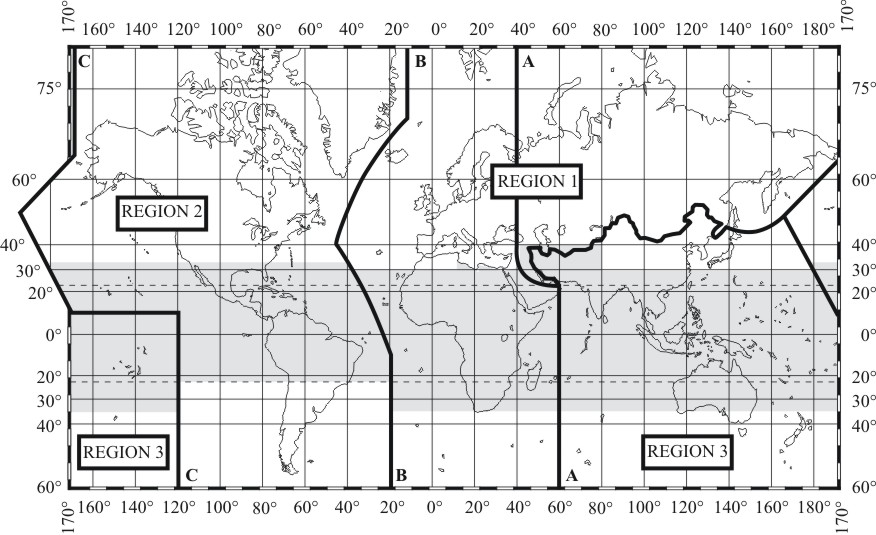
The Telecommunications Authority of Trinidad and Tobago (TATT) has initiated a public consultation on point-to-point radiocommunications systems.  According to the consultation document, the TATT is seeking firstly to identify the various frequency bands of operation deployed globally and, in particular, by International Telecommunications Region 2 countries, taking into consideration the frequency bands and assignment plan presently used by point-to-point systems locally. Secondly, the TATT seeks to analyze and summarize the current spectrum availability for the associated frequency bands in Trinidad and Tobago. Finally, based on the above information, the TATT proposes frequency bands and associated assignment plans for the accommodation of point-to-point radiocommunications systems and indicates the appropriate licensing process for the assignment of spectrum to users.

The specific bands discussed in this consultation documents are 1.4 GHz, 2.4 GHz, 5 GHz, 5.7 GHz, 5.8 GHz, Lower 6 GHz, Upper 6 GHz, 7 GHz, 8 GHz, 10 GHz, 11 GHz, 13 GHz and 15 GHz. As a general rule, the TATT appears to have rejected the idea of a competitive licensing process for this spectrum and is proposing instead to adopt a "first-come, first served" licensing process (with the exception of the 2.4, 5.7 and 5.8 GHz bands, where the TATT is proposing a class licensing regime and the Upper 6 GHz band, which the TATT is proposing to set aside for Studio-to-Transmitter Links). This approach is consistent with international best practice.

While backhaul has traditionally been carried on copper wire or fiber, telecom operators worldwide are increasingly turning to wireless technology for capacity to meet the increased demand created by growing numbers of bandwidth-hungry mobile devices and applications. Wireless backhaul is particularly desirable in the Caribbean, where laying wire or fiber is often cost-prohibitive. Telecommunications regulators around the world are attempting to come to grips with this important component of modern telecommunications infrastructure. The U.S. Federal Communications Commission, for instance, is currently in the midst of a proceeding on this topic.  The TATT is therefore to be congratulated for tackling such an important issue.

Comments are due October 13, 2010

Friday, September 3, 2010

Jamaica Supreme Court Dismisses LIME Application for Injunctive Relief

Jamaica Supreme Court Justice Ingrid Mangatal
Yesterday, Justice Mangatal of the Jamaica Supreme Court dismissed an application by LIME for injunctive relied against Digicel as part of an ongoing court proceeding over fixed-to-mobile termination rates.  Justice Mangatal's decision provides a good overview of the legal test for injunctive relief in Jamaica (and other common law jurisdictions). She concluded that, while there appears to be serious issues to be tried in this proceeding, LIME did not provide sufficient evidence to demonstrate that the balance of convenience justifies injunctive relief.

In the main proceeding, LIME claims that Digicel's conduct in setting higher rates for the termination of fixed line calls from other networks to call Digicel's mobile network, while setting lower rates for calls from Digicel's fixed network to Digicel's mobile network, is an abuse of dominant position under the Fair Competition Act.  LIME also alleges that, under section 30 of the Telecommunications Act, Digicel did not comply with the obligation to provide interconnection on a non-discriminatory basis.  Accordingly, LIME argues that it has a private cause of action under section 48 of the Fair Competition Act and section 67 of the Telecommunications Act.

Interestingly, as part of its defence in the main proceeding, Digicel denied the existence of  "market to terminate calls on Digicel's mobile network".  This position is consistent with Digicel's arguments before the Telecommunications Appeals Tribunal (as previously discussed on this blog).  It is clearly at odds, however, with the conclusions of the Telecommunications Appeals Tribunal, as well as the position taken by the International Telecommunications Union and telecommunications regulators around the world, most of whom have concluded that mobile termination is a distinct market that requires regulation.  In her decision, Justice Mangatal seemed reluctant to delve into such a detailed and complex economic analysis.  It will be interesting to see if the trial judge will rule on this important issue.

Wednesday, July 14, 2010

Bermuda Telecom Bill Delayed

In early July, the Ministry of Energy, Telecommunications and E-Commerce (METEC) in Bermuda announced that the tabling of the new telecommunications legislation would be delayed.  METEC Minister Michael Scott had previously told the industry that he would table the legislation prior to the summer recess.  According to a July 2 report in The Royal Gazette, "The Minister will update industry on its new time table as early as possible". 


As previously mentioned on this blog, the telecommunications legislation in Bermuda is in serious need of modernization. The fact that Bermuda does not have an independent regulatory body responsible for telecom and broadcasting regulation is clearly at odds with international best practices.  The International Telecommunications Union, for instance, in its most recent report on Trends in Telecommunication Reform (2009), describes the need for independent regulatory agencies as follows (see page 7 of Executive Summary):

The creation of separate ICT regulators has been one of the main building blocks of regulatory
reform worldwide since the 1990s. Regulators have played a leading role in creating an enabling
environment fostering innovation and investment. They have gradually opened fixed line services to
competition totaling 124 competitive markets for basic fixed-line services as of 2009, almost
inevitably privatizing the national fixed-line incumbent along the way. The overall objective of
regulators has been to ensure that public policy objectives for the sector continued to be met and
even exceeded.
Despite the need for legislative change in Bermuda, METEC's decision to delay the tabling of this legislation appears to be reasonable, given the feedback received from industry stakeholders.  The cost of the new regulatory agency was estimated to be approximately US $9 million per year.  This amount was heavily criticized by industry stakeholder, both in their regulatory submissions and media reports.  Indeed, this amount seems very high when compared to similar jurisdictions such as the Cayman Islands, where the regulator's annual budget is US $1.8 million (see page 269 of this budget document).  In the Bahamas, where the population is 330,000, or five times the Bermuda population, the annual budget of the telecom regulator is approximately $5 million (see page 21 of this draft annual plan).  Hopefully, the Government of Bermuda will rectify these issues in the near future to ensure that Bermuda's telecom regulatory framework is consistent with international best practices.