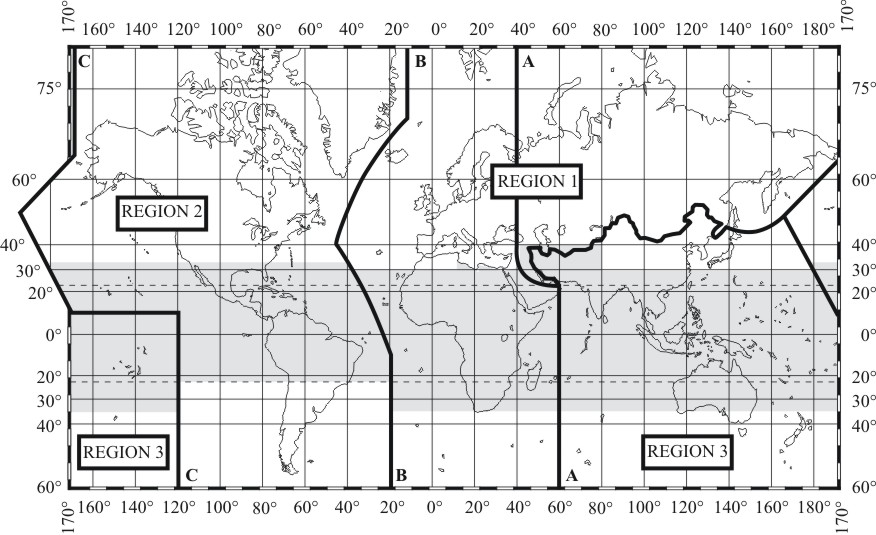
The Telecommunications Authority of Trinidad and Tobago (TATT) has initiated a public consultation on point-to-point radiocommunications systems. According to the consultation document, the TATT is seeking firstly to identify the various frequency bands of operation deployed globally and, in particular, by International Telecommunications Region 2 countries, taking into consideration the frequency bands and assignment plan presently used by point-to-point systems locally. Secondly, the TATT seeks to analyze and summarize the current spectrum availability for the associated frequency bands in Trinidad and Tobago. Finally, based on the above information, the TATT proposes frequency bands and associated assignment plans for the accommodation of point-to-point radiocommunications systems and indicates the appropriate licensing process for the assignment of spectrum to users.
The specific bands discussed in this consultation documents are 1.4 GHz, 2.4 GHz, 5 GHz, 5.7 GHz, 5.8 GHz, Lower 6 GHz, Upper 6 GHz, 7 GHz, 8 GHz, 10 GHz, 11 GHz, 13 GHz and 15 GHz. As a general rule, the TATT appears to have rejected the idea of a competitive licensing process for this spectrum and is proposing instead to adopt a "first-come, first served" licensing process (with the exception of the 2.4, 5.7 and 5.8 GHz bands, where the TATT is proposing a class licensing regime and the Upper 6 GHz band, which the TATT is proposing to set aside for Studio-to-Transmitter Links). This approach is consistent with international best practice.
While backhaul has traditionally been carried on copper wire or fiber, telecom operators worldwide are increasingly turning to wireless technology for capacity to meet the increased demand created by growing numbers of bandwidth-hungry mobile devices and applications. Wireless backhaul is particularly desirable in the Caribbean, where laying wire or fiber is often cost-prohibitive. Telecommunications regulators around the world are attempting to come to grips with this important component of modern telecommunications infrastructure. The U.S. Federal Communications Commission, for instance, is currently in the midst of a proceeding on this topic. The TATT is therefore to be congratulated for tackling such an important issue.
Comments are due October 13, 2010.
Commentary on Recent Developments in Caribbean Telecommunication and Broadcasting Law and Regulation
Showing posts with label Trinidad and Tobago. Show all posts
Wednesday, September 15, 2010
Wednesday, August 25, 2010
Mobile Phones and Driving Safety
According to the Guardian, the Trinidad and Tobago Cabinet has endorsed amendments to the motor vehicle legislation to ban the use of mobile devices while driving. These amendments will soon be tabled in the Trinidad and Tobago Parliament. In a post-Cabinet news conference on July 29, Works and Transport Minister Jack Warner noted that these amendments are intended to increase road safety in Trinidad and Tobago. Both Digicel and TSTT expressed their support for these amendments.
These amendments should be a no-brainer for all Caribbean nations. Several studies have demonstrated clearly that using a mobile device while driving a motor vehicle entails a similar risk as driving while intoxicated. A significant number of nations have already adopted and implemented legislation to prohibit this practice. One can only hope, therefore, that the other Caribbean nations will follow Trinidad and Tobago's lead in the near future.
Labels:
Digicel,
Driving Safety,
Legislation,
Parliament,
Trinidad and Tobago,
TSTT
Friday, May 28, 2010
When will Cable & Wireless rollout its IPTV service in the Caribbean?
Yesterday, Cable & Wireless Communications made several references to its forthcoming Caribbean IPTV rollout during the presentation of its 2009/2010 financial results. Whilst much of the discussion was focused on CWC's TV service in Panama, the rollout of TV services across the Caribbean was also mentioned on a couple of occasions, including during the Q&A's with financial analysts. It was described as one of CWC's 2010/2011 priorities on page 30 of the slides.
These comments are consistent with a press release issued last fall, in which CWC announced a partnership with U.S.-based Move Networks for a rollout of IPTV services across CWI’s global operations. Yesterday, Telecommunications Services of Trinidad and Tobago (TSTT), which is owned jointly by the Government of Trinidad and Tobago and CWC, announced a similar partnership with another U.S.-based IPTV provider, Calix Inc.
Entering the Caribbean TV market will not be easy for CWC. In addition to the challenges associated with securing the intellectual property rights for popular US programming, CWC will need to convince the local population that its service is superior than the grey and black market satellite services, which are currently rampant across the Caribbean. Perhaps one way to accomplish this objective is to deliver a comprehensive list of local Caribbean TV channels and to focus on IPTV's ability to deliver advanced TV services which are not available on satellite, including interactive services, VOD services and "TV Everywhere" services.
These comments are consistent with a press release issued last fall, in which CWC announced a partnership with U.S.-based Move Networks for a rollout of IPTV services across CWI’s global operations. Yesterday, Telecommunications Services of Trinidad and Tobago (TSTT), which is owned jointly by the Government of Trinidad and Tobago and CWC, announced a similar partnership with another U.S.-based IPTV provider, Calix Inc.
Entering the Caribbean TV market will not be easy for CWC. In addition to the challenges associated with securing the intellectual property rights for popular US programming, CWC will need to convince the local population that its service is superior than the grey and black market satellite services, which are currently rampant across the Caribbean. Perhaps one way to accomplish this objective is to deliver a comprehensive list of local Caribbean TV channels and to focus on IPTV's ability to deliver advanced TV services which are not available on satellite, including interactive services, VOD services and "TV Everywhere" services.
Labels:
Cable and Wireless,
Calix,
LIME,
Move Networks,
Panama,
Pay TV,
Trinidad and Tobago,
TSTT
Wednesday, May 12, 2010
Consultation on Number Portability in Trinidad and Tobago
The Telecommunications Authority of Trinidad and Tobago is currently conducting a public consultation on number portability. Comments are due on May 28th.
After several years of delay (compared to the rest of the world), the Caribbean telecom regulators in the Caribbean are now finally forging ahead with NP. Although the French West Indies (French Guyana, Guadeloupe and Martinique) have already done so, most of the other jurisdictions are expected to follow suit in 2011 and 2012. The Cayman Islands are expected to have NP available for both mobile and fixed telephony within the next few months. Bermuda has completed two separate public consultations on this topic (in 2008 and 2009) and the Bahamas Utilities Regulation & Competition Authority has indicated in its latest annual report that it intends to do the same in Q3 2010. Jamaica has issued a request for expressions of interest from potential vendors.
It will be interesting to see what impact NP will have on Cable & Wireless/LIME dominance in the Caribbean fixed telephony sector.
After several years of delay (compared to the rest of the world), the Caribbean telecom regulators in the Caribbean are now finally forging ahead with NP. Although the French West Indies (French Guyana, Guadeloupe and Martinique) have already done so, most of the other jurisdictions are expected to follow suit in 2011 and 2012. The Cayman Islands are expected to have NP available for both mobile and fixed telephony within the next few months. Bermuda has completed two separate public consultations on this topic (in 2008 and 2009) and the Bahamas Utilities Regulation & Competition Authority has indicated in its latest annual report that it intends to do the same in Q3 2010. Jamaica has issued a request for expressions of interest from potential vendors.
It will be interesting to see what impact NP will have on Cable & Wireless/LIME dominance in the Caribbean fixed telephony sector.
Subscribe to:
Posts (Atom)